I Have Spoken: The History of Mac and Cheese, As I Know It
Article 2 of the "I Have Spoken" series - Mac & Cheese
By jerome amosMay 1, 2026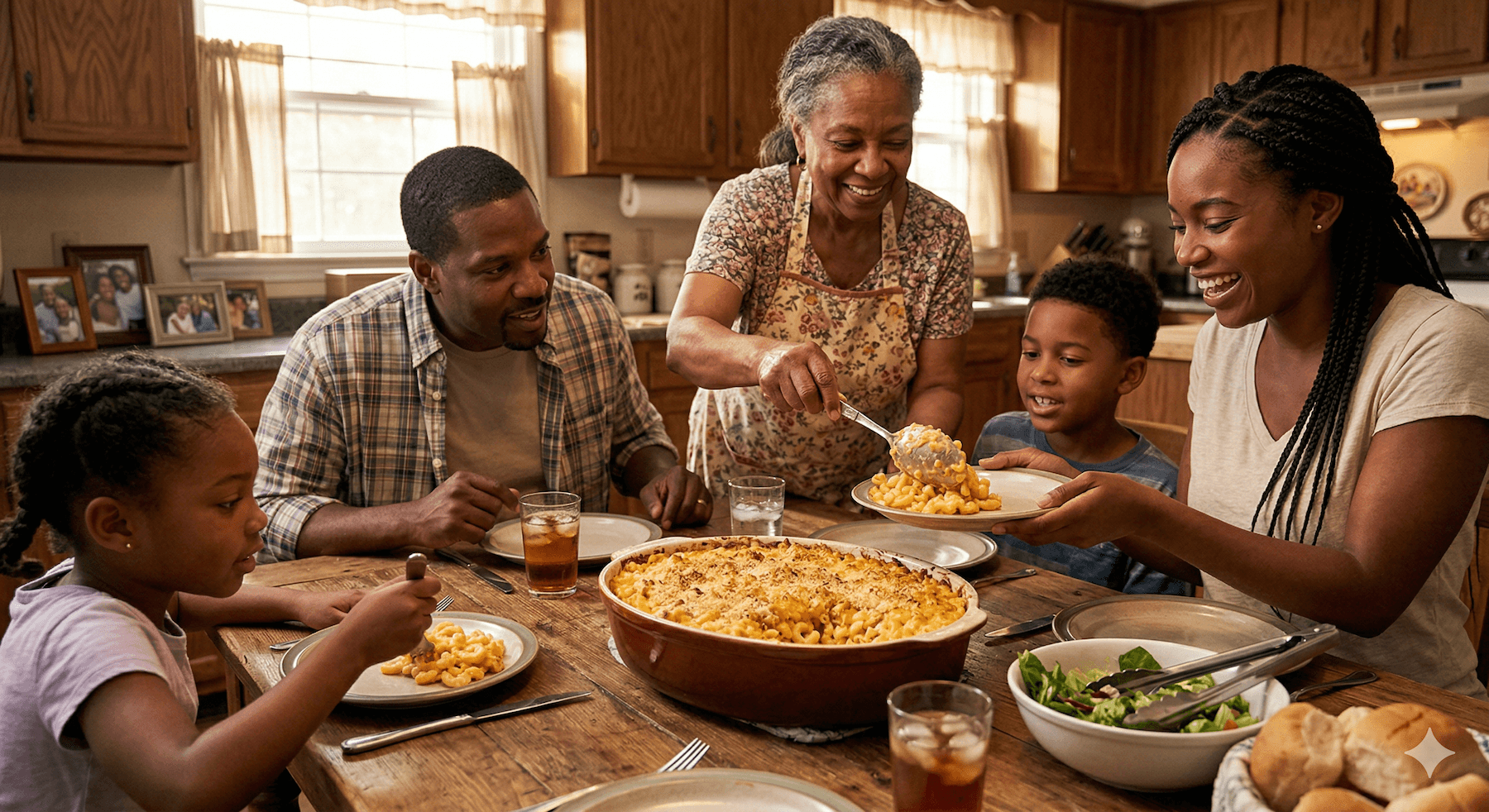
Article 2 of the "I Have Spoken" series - Mac & Cheese
I Have Spoken: The History of Mac and Cheese, As I Know It
Article 2 of the "I Have Spoken" series
Let me tell you something about my family's Easter dinner.
We're talking about twenty people — sometimes more, depending on who came through after church — packed around every table in the house. And the spread was serious. Glazed baked ham with the pineapple rings on top, a maraschino cherry in the center of every ring, the whole thing lacquered and golden. Greens cooked down low and slow with smoked ham hock or bacon. Green bean casserole. Candied yams loaded with marshmallows. Corn and cornbread. And Nana's fried chicken — which was its own thing entirely, made with corn flakes in the coating, a detail I will defend forever as inspired.
I know I'm forgetting a dish or two. There was always something I'm forgetting.
And then, sitting right in the center of all of it — not off to the side, not tucked in a corner, center of the table — the baked mac and cheese. Hot. Bubbling. Yellow cheddar, sharp and rich, with a bread crumb top baked to a perfect golden crust. That dish didn't move until it was gone. It was the anchor. Everything else on that table was wonderful, but the mac and cheese was the thing people talked about on the way home.
Mac and cheese was an Easter fixture, a Thanksgiving fixture, a Christmas fixture — basically a permanent resident of any family gathering between September and April. But come summer? Gone. Nobody was turning the oven on in July for a casserole. Summer had its own food — grills, cold sides, things that didn't require standing over heat in a kitchen. The mac and cheese was a cold-weather dish, seasonal in the way that some food just is, even if nobody ever said that out loud.
Now me? I've been messing with the family formula for years. Multiple cheeses — sharp cheddar as the base, Gruyère for nuttiness, Colby for the melt, smoked gouda when I'm making a statement. Thick-cut bacon, cooked down and folded in, because that's my spin on something I was handed as a tradition. I regret nothing.
But here's the thing about mac and cheese that nobody at the table ever talks about while they're going back for thirds: this dish has one of the most genuinely unhinged origin stories in all of food history. We're talking Arab traders, medieval royal courts, a 1760s British fashion disaster that somehow ended up in an American patriotic song, an enslaved chef who was the most technically skilled cook in early America, and a Scottish salesman in the Great Depression who changed what "dinner" meant for millions of families.
You think you know this dish. You have no idea.
Sit down. Let's go.
When most people tell the history of mac and cheese, they start with Thomas Jefferson. Sometimes James Hemings. Sometimes Kraft. Those are all important chapters — but none of them are the first page.
The first page is 9th-century Sicily. And the people who wrote it were Arab.
In 827 CE, Arab forces began their conquest of Sicily and had it largely under control by around 902. They brought with them a culinary technology that had been developing across the Arab world for centuries — dried pasta made from durum wheat semolina. Not the fresh pasta you roll out at home, which falls apart the moment you try to dry it. Semolina pasta — high protein, high gluten, made from hard durum wheat — which holds its shape when dried. For months. Pack it on a ship. March it with an army. Store it through winter. It was the original shelf-stable convenience food, and it was revolutionary for exactly the same reason the Kraft box was revolutionary a thousand years later: it meant you could feed people anywhere, any time, without fresh ingredients.
The Arabic word for it was "itriyya" — string-like shapes of semolina, dried before cooking. A 9th-century Arab physician named Isho bar Ali put it in his dictionary. The word traveled into Italian dialects as "tria", and that word still lives in Sicily today — "vermiceddi di tria," pasta with chickpeas in Puglia called "tria e ciceri." The etymology never left. Language is a fossil record, and this one goes deep.
The single most important document for this story comes from a geographer named Al-Idrisi, working at the court of Roger II of Sicily in the 12th century. Roger II was a Norman king ruling over one of the most culturally layered societies of the medieval world — Christian, Muslim, and Jewish communities in the same space, which was unusual enough that historians still talk about it. Al-Idrisi described the town of Trabia, near Palermo, as a place with water-powered mills running a pasta production operation large enough to export — to Calabria, to the rest of the Mediterranean, to both Muslim and Christian territories.
This is not a home cook making dinner. This is a pasta export economy, running in Sicily in the 1100s.
And that technology, once it found the ships, found everywhere.
The first documented recipe combining pasta and cheese appears around 1304 in a Latin manuscript called the Liber de Coquina — "The Book of Cookery" — written for the Neapolitan court of Charles II of Anjou. The dish is called "de lasanis." Flat pasta cut into squares, boiled, tossed with grated cheese, layered with powdered spices. The Guinness World Records organization has officially recognized it as the first documented mac and cheese recipe, which is a sentence I never expected to write, but here we are.
That dish was luxury food. Parmesan-style aged cheese was expensive. The spice layering — spices traded like currency on the Silk Road — was status. This wasn't peasant food. It was showing off at a royal table.
Eighty-six years later, it shows up in England. In 1390, King Richard II had his royal chefs compile a cookbook called The Forme of Cury — "The Method of Cookery." Nearly 200 recipes, medieval English court cuisine at its finest. Buried inside is a dish called "Macrows":
"Take and make a thynne foyle of dowh. and kerve it on peces, and cast hem on boillyng water & see it wele. take chese and grate it and butter cast bynethen and above as losyns. and serue forth."
Thin dough, cut in pieces, boil it well, grate cheese and butter over it, serve. No cream sauce, no roux — pasta, cheese, and butter, layered. The English approach, direct and functional, and it absolutely works. Two continents, two centuries, same fundamental idea: pasta and cheese belong together. The dish is already traveling, already translating itself across kingdoms and kitchens.
By 1769, an English housekeeper named Elizabeth Raffald publishes The Experienced English Housekeeper, and her mac and cheese recipe — which she spells "Permasent Cheese" because spelling wasn't exactly standardized in the 18th century — calls for cream, butter rolled in flour as a thickener, and Parmesan toasted on top. That butter-rolled-in-flour is a roux precursor. That's starch stabilizing a sauce against breaking. That's exactly the technique James Hemings is about to become famous for — fifteen years before he ever set foot in Paris.
Write that down. It's going to matter.
Before we get to Hemings, I have to tell you one of my favorite facts in this entire story, because it's too good to skip. In 1760s Britain, "macaroni" was slang for being the height of fashionable sophistication. And that is how it ended up in "Yankee Doodle."
After the Seven Years' War ended in 1763, wealthy young English aristocrats flooded onto the Continent for the Grand Tour — the trip through France and Italy considered essential education for any cultivated gentleman. They came back from Naples and Rome with a taste for Italian pasta and an extremely specific fashion sense, and they formed what became known as the Macaroni Club in London. The look was: towering wigs two feet high topped with a tiny hat, gold embroidery and lace ruffles, striped stockings, bright red heels. To describe anything as "very macaroni" was to call it the absolute peak of Continental sophistication.
"Yankee Doodle" was written by the British to mock American colonists. The joke: a bumpkin American sticks a feather in his cap and calls it "macaroni" — meaning he thinks one feather makes him fashionable. The British audience laughs at the idea of an unsophisticated colonial imagining he could compare himself to the elaborate Macaroni dandies.
The Americans heard this song. Found it hilarious. Adopted it as a patriotic anthem. Sang it at the British at Yorktown.
The mockery was so thorough it became a point of pride. That is a very American move.
So to recap: the pasta that Arab traders brought to Sicily in the 9th century had, by the 1760s, become so embedded in European elite culture that it was being used as an insult in a song about the founding of a nation. That's a thousand years of culinary travel in one lyric. And the story is just getting started.
Thomas Jefferson went to France in 1784 as the U.S. Minister, and his relationship with pasta bordered on obsessive. In 1787 he toured northern Italy, wrote detailed notes on pasta-making — "the best pasta in Italy is made with a particular sort of flour, called Semola, in Naples" — and sketched a pasta-making machine. That drawing is at the Library of Congress right now. He wrote his secretary in Europe asking him to procure a pasta mold from Naples, had it shipped to Philadelphia, packed it for Monticello. Jefferson was importing hardware for a pasta hobby.
But Jefferson didn't go to France alone. He brought with him a 19-year-old enslaved man named James Hemings.
Hemings was born in 1765, enslaved in Virginia. He was the son of Elizabeth Hemings and John Wayles — which made him the half-brother of Jefferson's wife Martha. When Martha Jefferson died and Jefferson inherited from her estate, Hemings came with it. That family connection is uncomfortable and important, and I'm not going to smooth it over.
Once in France, Jefferson sent Hemings to train in professional French kitchens. What followed over the next five years was serious culinary education: training under Monsieur Combeaux, a Parisian caterer and restaurateur; work alongside pastry chefs in the household of the Prince de Condé. Five years in French haute cuisine at a professional level — not observation, not crash courses, but actual hands-on training in the full system. The roux. The béchamel. The sauce architecture of the most sophisticated culinary tradition in the world. By the time James Hemings came back to America, he was arguably the most technically trained chef in the country.
At Monticello's state dinners, Hemings's macaroni pie was a showstopper. Jefferson served it at the White House in 1802 to guests who reportedly had no idea what they were eating. The handwritten Monticello mac and cheese recipe that survives is in Jefferson's hand, but scholars believe it was dictated by Hemings or Edith Hern Fossett, the enslaved woman who later served as Jefferson's head cook at the White House. Jefferson wrote it down. The knowledge came from the kitchen — his kitchen, run by people who received no credit for it.
Here's where I need to say something plainly, because this matters.
James Hemings did not invent the béchamel. He did not invent pasta and cheese — that's been in cookbooks since 1304. Elizabeth Raffald's recipe fifteen years before his Paris training shows the cream-and-flour approach already in English domestic cooking. What Hemings did was bring professional mastery at a level America had never seen, applied to the most important dining table in the new country. He translated a European dish into the American context with extraordinary precision and trained the next generation to carry it forward. That's the real credit. It is still enormous. And it is still not given to him.
This is not a new story. Korean fried chicken — one of the most beloved dishes in that country's modern food culture — traces part of its technique to Black American GIs stationed in Korea during the war. They brought their frying traditions, their heat management, their way with seasoned oil. The dish absorbed it, was transformed by it, and became something iconic. And when you read about Korean fried chicken, those men are rarely mentioned. The contribution happened. The credit didn't follow.
The pattern is the same: Black culinary genius flows into a tradition, elevates it, becomes inseparable from it, and then gets traced back to everything except the people who actually built it. James Hemings walked into the most technically demanding kitchens in the world, mastered them under conditions of captivity, brought that mastery home to a country he helped feed — and the dish he's most associated with still gets credited to the man who owned him.
He was free for five years. He died in Baltimore in 1801, at 36 years old.
Before he left Monticello, he made sure the knowledge didn't leave with him. He trained his brother Peter Hemings — systematically, deliberately — in everything he knew. A man about to become free ensuring the work stayed in his family rather than disappearing. That is its own kind of defiance.
I'm a chef. I can't tell this story without talking about why the technique matters, because once you understand it, you can't unknow it.
Cheese is an emulsion — water and fat held together by proteins called caseins, stabilized by calcium. Stable at room temperature. Apply heat, and those proteins aggregate — they clump together and squeeze the fat out in greasy pools. You've seen this. It's what happens when you throw bagged shredded cheese straight into a hot pan. That's not bad cheese. That's physics.
A roux — fat and flour cooked together — builds a starch network that physically catches the cheese proteins as they relax under heat. The network gets in the way of the clumping. Fat stays distributed. Sauce stays smooth. The rule: add cheese off the heat, or on very low. The roux helps. It does not make you invincible.
Now here's the thing your grandmother probably knew without being able to explain it: Velveeta does the same job through entirely different chemistry. When J.L. Kraft was developing processed cheese in the early 20th century, he was working with emulsifying salts — compounds that bind the calcium ions in cheese. Without free calcium, casein proteins can't crosslink and clump even under high heat. They stay fluid and smooth. This is why Velveeta melts like liquid glass. This is why it doesn't break.
Swiss food scientists figured this out in 1912 while studying why fondue stays smooth — the tartaric and citric acids in white wine were doing this calcium-binding work. Kraft industrialized it into a shelf product. Your grandmother throwing Velveeta alongside sharp cheddar in her baked mac was not taking shortcuts. She was applying technically sound emulsification chemistry passed down as kitchen wisdom. Give her the credit she deserves.
My own approach: sharp cheddar as the base, Gruyère for nuttiness, Colby for the melt, smoked gouda when I want to say something. A proper roux. Thick-cut bacon cooked down and folded in. This is not Nana's recipe. It's mine, built on hers, which was built on something older. That's how food works. You receive a tradition and you write the next chapter.
After emancipation, this dish did something remarkable.
The plantation kitchen had been a place of serious, highly skilled culinary work — almost entirely unpaid and completely uncredited. Enslaved cooks who knew how to build a roux, manage a béchamel, and turn out technically demanding food at a professional level took that knowledge with them when they were free. They didn't leave it behind.
Mac and cheese in Black American communities became something different from the Jefferson version. Not a state dinner centerpiece. A dish of celebration — made when there was enough to share, brought to the table at gatherings that mattered. Sunday dinners after church. Easter. Thanksgiving. The seasonal rhythm my family followed without ever thinking about why.
And the recipe evolved into something structurally new. The soul food baked mac and cheese is not the Raffald recipe with extra cheese — it's a different construction. Multiple cheeses for different functions. A base that includes eggs, which set during baking into a dense, rich custard rather than a loose sauce. An interior that holds its shape and can be sliced. A top that goes deep golden. This dish is sliceable. Dense. The kind of thing you cut into squares and put on a plate and it stays there. This is not a European gratin with additions. This is something new, built on the same foundation, by people who understood both the technique and the stakes.
Abby Fisher, a formerly enslaved woman who made her way to San Francisco, published what is considered the first soul food cookbook in 1881. Rufus Estes, formerly enslaved and later a Pullman railway car cook, published Good Things to Eat in 1911. His book traveled. The Great Migration carried all of it — the technique, the recipes, the tradition — from the rural South to Chicago, Detroit, Harlem, and Oakland. Mac and cheese went with every one of those moves. It arrived in every new city as a piece of home.
It's 1937. The Great Depression is grinding. A salesman named Grant Leslie — from Dundee, Scotland, working out of St. Louis — has a simple idea. He starts rubber-banding packets of Kraft grated cheese to boxes of dry macaroni and selling them as a package.
Kraft heard about it. Hired Leslie. Launched Kraft Dinner nationally at 19 cents a box with the slogan "Dinner for four in nine minutes." Eight million boxes sold the first year.
During World War II, rationing made it even bigger. Meat and fresh dairy were heavily rationed. Kraft Dinner needed only one ration stamp for two boxes, making it one of the most efficient meals a family could put on the table. Fifty million boxes sold during the war years. After the war, it stayed — and stayed, and stayed, and stayed.
Here's my honest take on Kraft: it solved a real problem for real families during genuinely hard times. Millions of people were fed, especially children. That matters. Kraft is for someone's kids, not mine — but it's for someone's kids, and that's not nothing. What I won't let slide is the way it separated the dish from the knowledge behind it. A generation grew up eating something called "mac and cheese" without any reason to understand why a roux works, what it means to add cheese off the heat, or why the egg in a baked version sets differently than a sauce. The dish survived. The technique didn't always come with it. That trade-off is worth naming.
Here's where I land at the end of all of this.
The blue box and the soul food baked mac and cheese are not the same dish. They share a name and two ingredients. They don't share a recipe, a technique, a history, or a philosophy. The blue box is a nine-minute industrial product that does exactly what it says it does. The baked version — with the roux, the layered cheeses, the egg custard, the golden crust, the dense interior you can cut with a knife — carries a lineage through James Hemings in Paris, through Peter Hemings at Monticello, through Abby Fisher, through every church basement and holiday table where someone knew how to do it right.
My family's yellow cheddar version sits in that tradition. Mine, with the mixed cheeses and the thick-cut bacon, sits in that tradition too. I'm writing another chapter in a story that started with Arab traders on a Sicilian hillside over a thousand years ago.
This dish passed through Neapolitan courts and English royal kitchens and Parisian cooking schools. It was carried to America by a man who earned extraordinary skill under forced servitude and made sure the knowledge survived him. It was transformed by communities that built something new on the same foundation. And yes, it was democratized by a Scottish salesman with a rubber band and a box.
Every time someone pulls a casserole out of the oven at Thanksgiving — all of that is in there. Even if nobody at the table knows it.
Now they do.
I Have Spoken.
Now — do YOU have something to add? A family recipe, a memory, a regional version I missed, a correction? The floor is yours. The best food history is a conversation, not a lecture.
— Jerome, bfamcooking
A Note on Research
This is the second entry in my ongoing food history series. Like the first one, it's the result of real research — primary sources, food history scholarship, and AI-assisted fact-checking and cross-referencing, which I use openly and think is worth saying out loud. Jefferson's pasta machine sketch is at the Library of Congress. The Forme of Cury is on Project Gutenberg. The Monticello mac and cheese recipe is at the National Archives. I went to the sources.
The voice is mine. The opinions are mine. The bacon choice is absolutely mine and I stand by it.
Sources
Primary Sources
- Thomas Jefferson's Pasta Machine Drawing & Instructions, ca. 1787 — Library of Congress
- Thomas Jefferson's Macaroni & Cheese Recipe — National Archives
- The Forme of Cury (1390) — Project Gutenberg
- First Macaroni and Cheese — Guinness World Records
James Hemings & Monticello
- James Hemings — Thomas Jefferson's Monticello
- Macaroni — Thomas Jefferson's Monticello Encyclopedia
- Thomas Jefferson: A Man of the Pasta — Library of Congress Blog
- Love Mac and Cheese? You Can Thank James Hemings — HistoryNet
Medieval & European History
- Macaroni and Cheese — Wikipedia
- Medieval Cheese Pasta: Macrows — Eats History
- The 14th Century Origins of Macaroni and Cheese — Tasting Table
Arab & Italian Origins of Pasta
- The Origin of Pasta: In Sicily, During Arab Domination — Three Farms Island
- Tria: An Italian Pasta with a Hebrew Name — Tel City
- Origin of Pasta Part 1: From Ancient Etruscans to Arab Influence — Edible Origins
The Macaroni Club & Yankee Doodle
- The Macaroni Craze — Historic UK
- The Macaroni Club: Fashion History's Forgotten Drag Subculture? — Messy Nessy Chic
- Meet the Macaronis — History Today
Black American Culinary History
- Black History of Mac and Cheese — The Soul Food Pot
- Soul Food Macaroni and Cheese: Iconic Status in Black Homes — Cuisine Noir
- Nourishing Our Nation: A Brief History of African American Cuisine — Atlanta History Center
Kraft & the Blue Box
- Kraft Dinner — Wikipedia
- The History of Kraft Macaroni & Cheese — Back Then History
- Who Really Invented Kraft Mac & Cheese? — Flavor365
The Science

jerome amos
Jerome Amos is a native New Yorker, foodie, and chef who learned to cook as a young child. His older relatives, boy scout training, and desire to help prep the Sunday church potluck meals profoundly influenced Jerome's early love of preparing and sharing delicious recipes and creating a connected community.
Jerome of BFAM Cooking By the age of 10, Jerome was making his meals and operating the grill at family BBQs. He continued to learn and expand his culinary experience by trying new techniques and observing his grandmother preparing her family recipes. Jerome began working in restaurants in high school, moving his way up from dishwasher to kitchen prep. Jerome got married, joined the military, and didn't level up his cooking until a few years after the USAF when he and his wife watched The Food Network. Their shared passion for cooking led them to take cooking classes and attend significant food events where celebrity chefs would appear and do cooking demos.
Understanding basic cooking techniques paired with the curiosity of making an idea work inspired Jerome and his wife to attend as many food events and cooking adventures as possible. This exploration has taken them worldwide, including Italy, where they learned about their surroundings through the local ingredients, recipes, and traditions. A turning point for Jerome took place in a Costco when he was doing his weekly grocery shopping and noticed a couple who was purchasing almost a dozen containers of BBQ sauce. Jerome had just taken a BBQ class and knew this guy had to be cooking up to something delicious.
After a brief conversation, Jerome and his wife were invited to this couple's BBQ, and a foodie friendship was born. Jerome and his new friend, Ellis, couldn't get enough chow chat, discussing everything from Southern flavor and French dishes to favorite chef knives and preferred salt. Together, they felt they had a lot to share with many other food lovers out there and B.F.A.M. Cooking (Brothers from Another Mother) was born on YouTube. Jerome, who had served in the US. Air Force for over five years, during the gulf war, said that the military way is to treat everyone on your team the same as your family.
That became the foundation for Brothers From Another Mother cooking or BFAM Cooking because everyone can be your "fam", especially at the dining table. The BFAM Cooking videos range from delicious, original recipes Jerome created to American restaurant owners who wanted to know better. There are also videos about cooking tools that he loves and simple techniques to make things easier. Jerome was recently one of the many chefs from around the globe who competed in an exclusive online competition to be named the world's Favorite Chef, receive $50,000, and a feature in two-page advertising spread in Bon Appétit announcing the winner. Voted on by the fans, Jerome made it as a semi-finalist, placing 3rd in his group.