I Have Spoken: The History of Chicken and Dumplings, As I Know It
*Article 3 of the "I Have Spoken" series* - Chicken and Dumplings
By jerome amosMay 17, 2026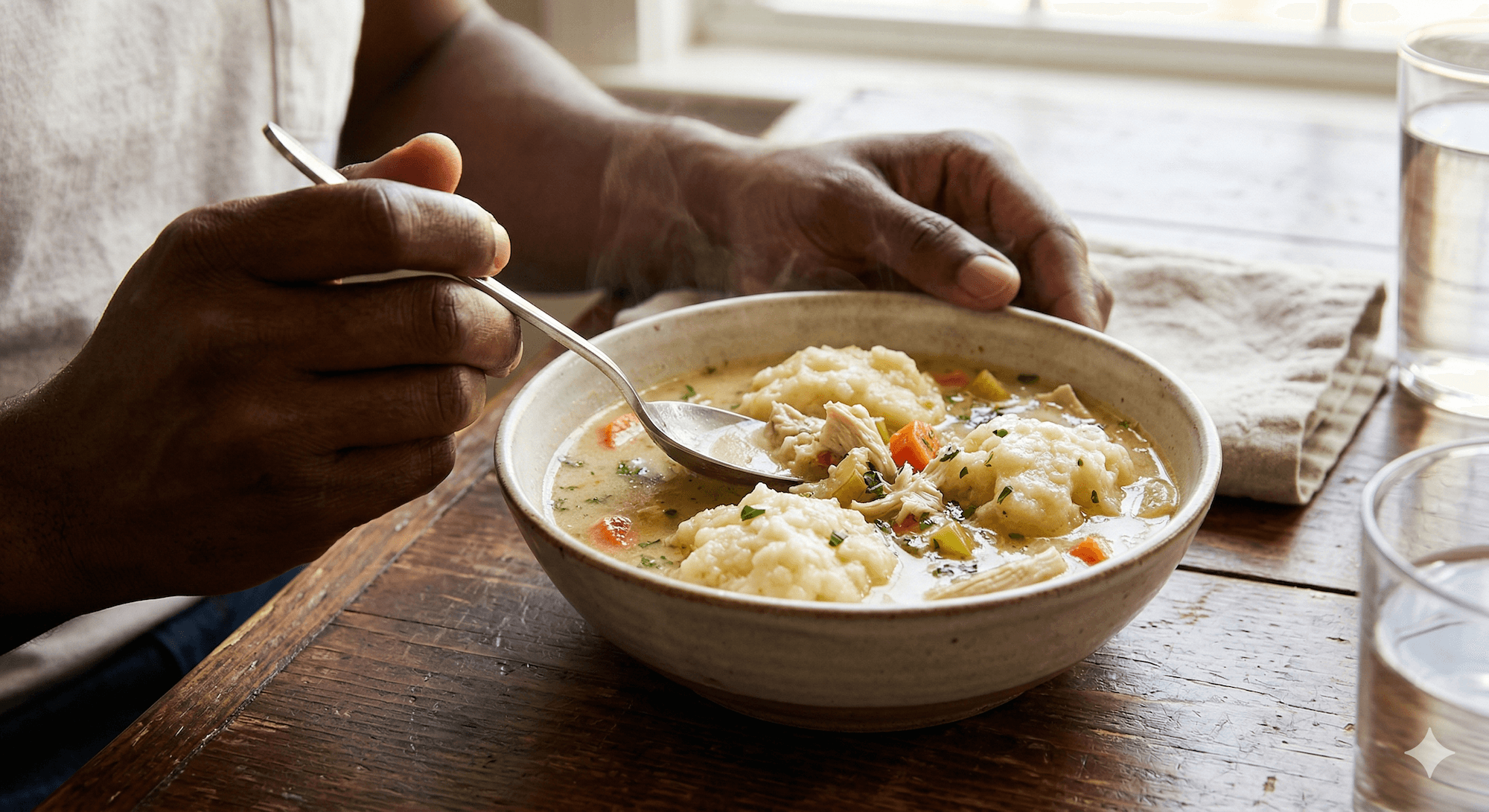
*Article 3 of the "I Have Spoken" series* - Chicken and Dumplings
First Things First — Why "I Have Spoken"?
Yes. I am a geek. Not just about food. About all of it — the science, the history, the stories, the lore. Star Wars, comic books, the periodic table of elements, the migration patterns of spice routes. If there's deep knowledge to be found in any corner of the universe, I want it. That's just who I am.
So when Disney+ dropped The Mandalorian in 2019, I was there on day one. And like a lot of people, I fell hard for a character that barely spoke and stole every single scene he was in: Kuiil — an Ugnaught, one of the pig-snouted, stocky humanoid species from the Star Wars universe, small in stature but massive in presence. Nick Nolte voiced him — and that voice, that slow, measured, worn-in-by-the-galaxy delivery, was perfect casting. (The physical performance on set was by Misty Rosas, who brought Kuiil's body language to life under that expressive face.)
Kuiil was a moisture farmer on a remote desert planet — Arvala-7, if you want the coordinates. He had earned his freedom from the Empire through years of hard, grinding labor. He wore patched work clothes. He rode a blurrg. He had no interest in drama, politics, or being anyone's hero. He was practical, he was dignified, and he did not waste words. When Kuiil decided something was true, he said it once, clearly, and then he ended the conversation with four words:
(And for those of you who haven't seen the show yet — fix that. Kuiil will be back in the upcoming theatrical film The Mandalorian & Grogu, and you'll want to know who he is before you walk into that theater.)
"I have spoken."
Not "I think." Not "in my opinion." Not "you might want to consider." Just — I have spoken. The research is done. The argument is settled. The subject is closed.
I love that line because it doesn't come from arrogance. Kuiil was never arrogant. It comes from certainty earned through experience. He'd done the work. He knew what he knew. And he wasn't going to pretend otherwise out of false modesty.
That's the spirit of this section.
"I Have Spoken — The History of Recipes As I Know It" is exactly what it sounds like: a deep dive into the history of the dishes we cook, love, argue about, and build traditions around. We're going to dig into the origins, the myths, the real stories, the forgotten characters, and the fascinating science behind the food on your table. We're going to be thorough. We're going to be honest about what we don't know as much as what we do. And at the end of every piece, when the research is exhausted and the story is told as completely as I can tell it?
I have spoken.
But here's the thing about Kuiil — even he left the door open. At the end of every conversation, every subject, you could still walk back up to his moisture farm and say "but wait, what about..." and if your argument was good enough, he'd hear it. So at the end of every article in this series, I'll ask: do YOU have something to add? Because the best food history is a conversation, not a lecture.
One more thing before we dive in: I'm a chef, not a historian. And the research that goes into these pieces is deep — deep enough that I don't pretend to do it alone. The voice is mine. The curiosity is mine. The opinions are absolutely mine. But the hours of sourced, cross-referenced research that fills these pages? That takes a village — and some of that village runs on large language models. I think that's worth saying out loud.
Now. Let's eat some history.
The One That Got Away
I need to tell you something before we get into the history. Something I don't say often, and something that cost me a little to admit.
I am a home cook. A serious one, a lifelong one, someone who has spent decades in kitchens — a few professional ones along the way, fast food lines, diners, places that taught me things — and I have built a food media brand around the idea that food history matters and that cooking is worth taking seriously. I have made beef bourguignon and wagyu and hand-rolled pasta and dishes that took three days to prepare. I know my way around a kitchen.
And I cannot make my grandmother's chicken and dumplings.
I haven't cracked it. Not once. Not yet.
My Nanna (you can read her full story here — she deserves her own reading) ran a kitchen that fed armies. Not metaphorically. There were at least eight people in that house at any given time when I was a kid, and she cooked for all of them, every day, without complaint and without measuring a single thing. She cooked the way people cooked before recipes were considered necessary — by feel, by memory, by the smell coming off the pot, by knowledge she'd built over a lifetime that lived in her hands and not on any card in any box.
Chicken and dumplings was a winter dish at her table. After Christmas, when the cold settled in and the holidays were done and people needed something that could warm you from the inside out and send you to the couch for a nap — that was when the big stockpot came out.
She would take a whole chicken and put it in that pot. Skin and all. She didn't bother taking the skin off — and I want to say this clearly, because I've thought about it since: she was right not to. The skin is fat, and fat is flavor, and all of that rendered chicken fat going into the broth over hours of slow cooking is a significant part of what made that pot taste the way it tasted. By the time the chicken was done, the meat was falling off the bone. The broth was deep and golden and thick with collagen and fat, the kind of broth that coats the back of a spoon and your mouth at the same time. You cannot buy that in a carton. You cannot rush it. You have to earn it.
The vegetables were exactly what chicken and dumplings has always been: peas, onions, carrots, celery, potato, thyme, black pepper. The same list you'd find in a chicken pot pie filling, which is not a coincidence — we'll get to that. What she was building in that pot was a thick, honest, working chicken stew. Not a soup. A stew. The kind where a spoon stands up a little.
And then came the dumplings.
Here is where I have to be honest with you, the way I was honest about Kraft in the mac and cheese piece. My grandmother's secret — the thing she reached for when it was time for the dumplings — was a yellow box.
Bisquick.
I know. I know. You would think a woman who cooked the way she cooked would have made her dumplings from scratch. I believe she once did, before Bisquick existed. But by the time I came along, Bisquick was in the house, and those were the dumplings she made. And here is the thing I will not apologize for saying: they were perfect. Light and airy, steamed to a soft pillow by the heat rising off the broth, cut into small squares — maybe an inch and a half on a side — so that you'd get four of them in your bowl alongside the thick stew and the falling-tender chicken. The Bisquick dumplings were not a shortcut. They were the right tool for the job, because what Bisquick actually is, stripped down, is pre-made biscuit dough mix: flour, leavening, salt, fat — all the ingredients for a proper drop dumpling, already measured and combined. It worked because the chemistry was correct. That's the whole story.
I talked to my cousin recently about this. We got on the subject of Nanna's cooking, the way you do, and we landed on the chicken and dumplings like we always do. And we sat with the same truth we always sit with: this is the one recipe the whole family wishes we had. And we don't.
It went with her.
So this article is something different for me. Every other piece I've written in this series, I've told you the history of a dish I've spent years mastering. This one, I'm telling you the history of a dish I'm still working toward. I'm going to recreate it. I'm going to get there. But I want to tell you the full story first — because the full story of chicken and dumplings turns out to be the story of how people fed each other through every hard thing America has ever faced. And my grandmother understood that story better than most, because she lived it.
She worked with the Red Cross. She fed people through the church. The kitchen wasn't just where she cooked — it was where she took care of people who needed taking care of. That stockpot, that big army-sized stockpot of chicken and dumplings after Christmas, was the same logic she applied her whole life: one chicken, stretched far enough, can feed everyone in the room. That is not Depression-era thinking. That is ancient thinking. And it turns out, it's the reason this dish exists at all.
Let me show you.
There's a naming problem we need to clear up before the history starts, because it's going to save us some confusion later.
When most people hear the word "dumpling," their mind goes somewhere specific — to Chinese jiaozi, perhaps, or Japanese gyoza, or Polish pierogi. Filled dough, sealed at the edges, a little package of something good. That is one thing. It is a beautiful and ancient thing. It is not what we're talking about.
The dumpling in chicken and dumplings is something else entirely. It is, at its core, a drop biscuit cooked in broth. No filling. No wrapping. No sealing. Just dough — flour, fat, leavening, liquid — dropped by the spoonful into hot broth and cooked by steam. It shares an English word with jiaozi and nothing else. Its actual ancestors are British. Its lineage runs through suet puddings and farmhouse kitchens and colonial American hearths, not through any Asian culinary tradition. The word "dumpling" got applied to both things, and the English language has been causing confusion about it ever since.
Now that that's settled — let's walk back to where it actually starts.
The English word "dumpling" first appears in writing in the early 1600s, and it described something simple: a lump of dough, dropped into hot liquid, cooked until tender. The fat of choice in Britain at that time was suet — the hard fat rendered from around beef or mutton kidneys — and the British had been dropping suet dumplings into broths and stews for as long as anyone had thought to write it down.
This was peasant food, working food, winter food. It required nothing expensive: flour, suet, salt, water, and a pot of something hot to drop it into. The dough absorbed the broth as it cooked, swelled, and turned from raw paste into something warm and filling and dense. You could stretch a thin stew into a meal with dumplings. You could feed more people from the same pot. The dumpling was always, at its heart, a way to make enough.
British colonists brought this tradition to America in the 1600s, and it settled in easily — the colonists had flour, they had fat, and they needed to feed families through long winters on whatever they had. A 1728 record from the Boston News Letter documents that a typical middle-class colonial dinner included puddings (which in that era meant boiled dough preparations of all kinds) alongside meat and bread. The dumpling was already domestic, already practical, already American before America was formally a country.
The German immigrant waves of the 1820s onward brought their own traditions into the mix: Knödel, large boiled dumplings made from bread or potato or flour; Spätzle, tiny soft egg dumplings scraped through a colander into boiling water. The Pennsylvania Dutch — German-speaking settlers in eastern Pennsylvania — made something called bott boi: square-cut noodle-dumplings simmered in broth with chicken and vegetables. In Pennsylvania Dutch, "pot pie" doesn't mean a baked pastry dish. It means this stew. The square noodle is the dumpling. That tradition is the direct ancestor of the flat, rolled "slick" dumpling that defines the Southern version of this dish.
And this is where the dish splits into two.
By the time chicken and dumplings appears in American cookbooks — Mary Randolph's The Virginia Housewife (1824) first, then Lettice Bryan's The Kentucky Housewife (1839), and finally the first recipe specifically pairing stewed chicken with dumplings in Marion Cabell Tyree's Housekeeping in Old Virginia (1879) — there were already two distinct approaches living side by side in American kitchens.
The Northern and Midwestern version: a thick, creamy stew with fluffy, biscuit-like dumplings dropped on top, cooked by steam, light and pillowy. Descended directly from British suet dumplings, adapted with baking powder once that was available, carried westward with settlement.
The Southern version: a thinner, brothier preparation with flat, rolled strips of unleavened dough — called "slick dumplings," or in Appalachia simply "chicken and slicks" — dropped into the broth and cooked submerged, absorbing the liquid, thickening it, ending up somewhere between a thick noodle and a soft pastry. Descended from the Pennsylvania Dutch bott boi tradition, filtered through Southern plantation kitchens, refined by Black cooks over generations.
Two dishes, one name. Both real. Both with deep roots. Both worth defending.
My grandmother's dish was the Northern tradition — the dropped, steamed, fluffy dumpling — and it lived in a Southern Black household. That's not unusual. These traditions moved together, blended together, and were carried in personal memory rather than cookbooks. The dish that ended up in your family's kitchen depended on who taught you, not on which side of the Mason-Dixon line you happened to be born.
And the people doing the teaching, for most of American history, deserve to be named.
When those 19th-century Southern cookbooks credited recipes to "250 notable Virginia housewives" or the genteel families of the planter class, they were describing who directed the kitchen. They were not describing who ran it.
The kitchens of the antebellum South were operated by enslaved Black cooks — men and women who worked at a professional level, who managed complex preparations for large households and for the entertaining that plantation society demanded, who built the flavor profiles and techniques of Southern cooking from the ground up. The credit went to the women whose names appeared on the cookbooks. The knowledge came from somewhere else.
One remarkable detail changes how I think about chicken and dumplings specifically: in the antebellum South, enslaved people were sometimes permitted to keep their own chickens. These garden chickens were among the very few economic assets an enslaved person could accumulate. They could sell eggs and birds at local markets, keep those proceeds, and in documented cases use that money toward purchasing their freedom. Chicken, in that world, was not just food. It was agency. It was the closest thing to ownership that the system permitted.
When emancipation came and Black families took their skills, their recipes, and their knowledge home — chicken and dumplings came with them. It moved from the plantation kitchen to the church kitchen to the community table. It became the dish you made when someone died. The dish you brought to the grieving family because it fed everyone, required only a pot and a bird, and took most of a day to make — which meant you were saying, with your hours, that you were present in their grief. In Appalachian and Southern communities, this is still true. Chicken and dumplings is specifically and repeatedly documented as funeral food, as community food, as the dish that appears when people need to be fed and someone has decided to show up.
My grandmother understood this from inside it. The Red Cross. The church. The soup kitchen logic of taking one chicken and making it reach everyone in the room. She didn't learn that from a cookbook. She learned it the way this knowledge has always traveled — from one person's hands to another person's memory.
Now let me tell you about the old hen, because nobody talks about this and everybody should.
Historically, chickens were not raised primarily for meat. They were raised for eggs. A hen would lay productively for a year or two and then her production would decline. Once she stopped earning her feed, the question was: what do you do with an old hen?
You cannot roast her, grill her, or fry her. Her muscles have spent years working — laying, walking, foraging — and are dense with connective tissue, tough in a way that high heat only makes worse. The only answer is low, slow, wet heat: simmer her in liquid for hours until the connective tissue dissolves into gelatin and the meat finally surrenders from the bone.
What that long simmer produces is something a young grocery store fryer cannot replicate. The dissolved collagen makes the broth thick and coating and rich in a way that commercial chicken stock, even good commercial stock, simply isn't. The meat, once it releases, is soft and deeply flavored and already falling into natural pieces. The broth is the dish. Everything else is in service of it.
Chicken and dumplings, in its original form, is the answer to the question of what you do with a bird you cannot afford to waste. The dumplings are the extender — flour and fat and water, the cheapest possible ingredients, turning one old hen into a meal that feeds a family with bowls to spare. My grandmother cooked a whole bird, skin and all, for exactly this reason. She knew something that most modern chicken and dumplings recipes have forgotten: you are not cooking chicken. You are building broth. The chicken is the vehicle.
The Great Depression did not invent this dish. I want to say that clearly, because the story that hard times gave birth to chicken and dumplings is everywhere and it is wrong. The dish was in cookbooks a full century before the Depression hit. It was already old by then.
What the Depression did was confirm it. When money was gone and pantries were bare and a family needed feeding, chicken and dumplings was already there — a dish built from the cheapest available ingredients, requiring only time and a pot. During World War II, when the federal government rationed red meat, beef, and pork, chicken and rabbit were left off the ration list entirely. Families who had been eating beef shifted to chicken. The dish that was already practical became essential.
For a generation of Americans, chicken and dumplings and the Depression fused into a single memory. The origin story followed. A dish that had been cooking in American kitchens since the 1820s got remembered as a Depression invention because for millions of people, it was the Depression meal — the one that was on the table when everything else ran out. Memory does not always sort the timeline correctly. It sorts by feeling.
The science of why my grandmother's dumplings worked is simple once you know it, and once you know it, you cannot unknow it.
A drop dumpling is a drop biscuit cooked in steam instead of an oven. The same rules apply.
Gluten is the enemy. When you mix flour with liquid, proteins in the flour link together into gluten — the network that gives bread its chew. In bread, you want that. In dumplings, you don't. Every extra stir you take after the dough comes together builds more gluten, which means denser, gummier, tougher dumplings. The right number of strokes to mix a drop dumpling dough is somewhere between fifteen and twenty. Mix until it just comes together. Stop. Put the spoon down.
Cold fat is the friend. Cold butter or cold lard cut into the flour leaves small solid fat pockets in the dough. When those hit the hot broth, the fat melts rapidly and leaves behind air pockets — which is what makes the dumpling light. Room temperature fat distributes evenly through the dough and leaves no pockets, no air, no lightness.
Steam, not boiling. Drop dumplings cook from below by gentle heat and from above by trapped steam. The lid must go on the pot and must stay on — the steam is doing half the work. A rolling boil destroys them; it drives too much heat into the dumpling too fast and breaks the delicate dough structure before it sets. A lifted lid lets the steam escape and collapses the dumplings. The rule is: set the lid, simmer gently, do not peek for fifteen minutes.
This is what Bisquick did correctly. Bisquick is flour, leavening, salt, and fat — already combined, already in the right proportions, already cut in so that cold fat is distributed evenly through cold dry mix. When you add cold liquid to Bisquick and mix minimally, you have exactly the dough structure that produces a light drop dumpling. My grandmother wasn't taking a shortcut. She was using a tool that had the chemistry built in. The dumplings were perfect because the chemistry was correct, not despite Bisquick but because of what Bisquick actually is.
I'll say the same thing here that I said about Kraft in the mac and cheese piece: a tool that works is a tool that works. Give it the credit it's owed.
What I'm building toward, when I finally sit down and make this dish the way it needs to be made, is something specific.
A whole chicken — a stewing hen if I can find one, because the old bird makes the broth and the broth makes the dish. Into the pot with the skin, the way she did it, because she was right. Simmered for hours until the meat falls away. The bird pulled out, stripped clean of skin and bone, the meat set aside in generous pieces. The broth strained and tasted and seasoned — and if it's thin, reduced until it isn't.
Then onion and celery softened in butter. A proper roux to thicken the sauce. The broth brought back in, the vegetables added — carrots, potato, peas last so they stay bright. Thyme. White pepper. The chicken folded back in. A thick, honest stew, the kind Nanna built.
And then dumplings. Mixed as little as possible. Cold fat. Cold buttermilk. The lid on and the heat steady and the patience to not lift that lid for fifteen minutes while the steam does its work.
Four dumplings in a bowl. Just like hers.
I'm not there yet. But I know what I'm aiming for. And now, after all this research, I understand why it worked the way it worked. That's new. That's something she had from feel and I'm arriving at from science, and I suspect when the two finally meet in the same bowl, I'll know I've gotten there.
This dish is older than America. It came from British suet kitchens and German immigrant traditions and Pennsylvania Dutch farmhouses and plantation kitchens run by Black cooks whose names rarely made the cookbooks. It became funeral food and church food and community food because it was always food that said I am here, and I am going to feed you. My grandmother knew that language fluently. She spoke it in the big stockpot after Christmas, in the Red Cross kitchen, in the church fellowship hall where she helped feed people who needed feeding.
One chicken. Enough for everyone.
That is what this dish has always been. That is what it still is.
And on the history of chicken and dumplings, as I know it —
I have spoken.
Now — do you have something to add? A family version I missed? A regional variation worth defending? A recipe that got away from you too? The floor is yours. This community knows things I don't. That's the whole point.
— Jerome, bfamcooking
A Note on Research
This is the third entry in my ongoing food history series. Like the others, it draws on deep research — primary sources, food history scholarship, and AI-assisted fact-checking and cross-referencing, which I use openly. The 1879 Housekeeping in Old Virginia recipe is documented. The Pennsylvania Dutch bott boi tradition is real and findable. The chemistry of why dumplings go gummy is basic food science.
The voice is mine. The opinions are mine. The ghost of Nanna's recipe is absolutely mine, and I'm going to catch it.
The Recipe: Chicken and Dumplings — Built the Right Way
The dish Jerome is working toward. Nanna's logic, understood from the inside.
Step One: The Chicken and the Broth This step is non-negotiable. The broth is the dish.
- 1 whole chicken, 3½–4 lbs — a stewing hen if you can find one; if not, the best whole bird available. Not parts. Not boneless. Not shortcuts.
- 1 large yellow onion, halved, skin on
- 3 stalks celery with leaves, roughly chopped
- 2 medium carrots, roughly chopped
- 6 garlic cloves, smashed
- 6–8 sprigs fresh thyme
- 2 bay leaves
- 8–10 whole black peppercorns
- 1 tbsp kosher salt to start
- Cold water to cover — about 12 cups
Place the whole chicken in your largest heavy pot or Dutch oven. Add all aromatics around it. Cover completely with cold water — starting cold draws impurities out slowly and produces a cleaner broth. Bring to a gentle boil, skimming any grey foam that rises in the first 20 minutes. Once the foam stops, reduce to a bare simmer — the surface should barely move.
Simmer partially covered: young fryer chicken, 1½ to 2 hours. Stewing hen, 3 to 4 hours. The meat should pull cleanly from the bones without effort. The broth should taste deeply of chicken — round, savory, with body.
Remove the chicken to a cutting board to rest. Strain the broth, discard the spent aromatics, taste and adjust salt. You should have roughly 8–10 cups. If it tastes thin, reduce it uncovered for 20–30 more minutes.
When the chicken is cool enough to handle, pull all meat from the bones by hand. Discard skin and bones. Tear into generous, natural pieces — not shredded, not cubed. Set aside.
Step Two: The Stew Chicken pot pie filling, minus the pie. Thick, honest, built for a bowl.
- The finished broth (8–10 cups, warm)
- 1 medium yellow onion, diced medium
- 3 stalks celery, sliced ¼-inch
- 3 medium carrots, sliced ¼-inch on a bias
- 2 medium Yukon Gold potatoes, peeled and cut ¾-inch
- 1 cup frozen peas — added last, never boiled
- 5 tbsp unsalted butter
- 5 tbsp all-purpose flour
- ½ cup heavy cream
- Fresh thyme, 4–5 sprigs
- Kosher salt and white pepper
In the same pot over medium heat, melt butter until foaming subsides. Add onion, cook until soft and translucent, about 6–7 minutes — no color. Add celery and carrots, cook 3 more minutes. Add flour all at once and stir constantly for 2 full minutes. This is the roux. Do not rush it.
Add warm broth in a slow, steady stream, whisking constantly. Add thyme and potatoes. Bring to a gentle simmer and cook uncovered until potatoes are just tender, about 15 minutes. Add the pulled chicken back in. Add cream. Taste aggressively — season with salt and white pepper until it's slightly more forward than you think it needs to be. The dumplings will absorb some of it.
The stew should be thick. It should coat a spoon heavily. A spoon should stand up a little. If it seems thin, simmer uncovered a few more minutes.
Do not add the peas yet. Hold at a gentle simmer.
Step Three: The Drop Dumplings A drop biscuit cooked in steam. Four rules. None negotiable.
- Mix the dough until it just comes together — then stop. Overworking = gummy.
- Cold fat, always. Room temperature fat = no lightness.
- The lid goes on and stays on. Steam is doing the work.
- Do not boil. Gentle simmer only.
- 2 cups all-purpose flour
- 1 tbsp baking powder
- 1 tsp kosher salt
- ½ tsp sugar
- 4 tbsp cold unsalted butter, cut into ¼-inch cubes
- ¾ cup cold buttermilk, straight from the refrigerator
- 2 tbsp fresh flat-leaf parsley, finely chopped (optional)
Whisk flour, baking powder, salt, and sugar. Add cold butter cubes. Work the butter into the flour with your fingertips until the mixture looks like coarse sand with some pea-sized pieces remaining. Those pieces matter — do not work to uniformity.
Pour in all the cold buttermilk at once. Stir with a fork — 15 to 20 strokes maximum. The dough should look shaggy and rough with visible dry patches. That is correct. Stop. Add herbs with two gentle folds. Rest 3 minutes.
Stir the frozen peas into the hot stew now — they just need warmth, not cooking.
Drop dumplings by heaped spoonfuls onto the surface of the simmering stew. Space them — they will expand. They should sit on top, not sink. If your stew is properly thick, they will float.
Lid on. Do not lift it for 15 minutes.
After 15 minutes: tops should be set and dry to the touch. A toothpick in the center should come out clean. If still wet, lid back on for 3–5 more minutes.
Serve in deep bowls. Ladle the stew and chicken, spoon dumplings on top. Crack black pepper over the top. Eat immediately.
Four dumplings in a bowl. Just like hers.
What goes wrong and why:
Gummy dumplings: Overworked dough. Mix less.
Dense, flat dumplings: Fat wasn't cold enough, or the lid was lifted. Cold fat, no peeking.
Dumplings that dissolve: The stew was boiling too hard, or you stirred after they went in. Gentle simmer only. Leave them alone.
Stew tastes flat: Under-seasoned before the dumplings went in. Season aggressively at the stew stage — you can't fix it after.
Peas turned grey: They went in too early. Add frozen peas only when the stew is ready for dumplings.
Sources
History & Origins
- Chicken and dumplings — Wikipedia
- The true history of Southern chicken and dumplings isn't what we thought — Southern Kitchen
- The Origins Of American Chicken And Dumplings Trace Back To The 1800s — Mashed
- What Came First, the Chicken or the Dumpling? — Saveur
- Chicken and Dumplings: The Great Equalizer of Southern Cooking — TASTE
- Chicken and Dumplings Was Originally A German Dish — Wide Open Country
British Dumpling Tradition
- The Dumpling Eaters — British Food: A History
- Sir Robert Walpole's Dumplings — History in the Making
Pennsylvania Dutch & Regional Traditions
- Chicken Pot Pie: A Beloved Pennsylvania Dutch Tradition — Experience Pennsylvania
- Cuisine of the Pennsylvania Dutch — Wikipedia
- WV Culinary Team: Dumplings in Appalachia — WV Gazette Mail
African American Culinary History
- Southern Chicken And Dumplings The Black Way — The Soul Food Pot
- How Enslaved Cooks Created Soul Food — PBS / Delishtory
- Slavery & Soul Food: African Crops and Enslaved Cooks — DIG Podcast
The Science
- Why Is My Chicken Drop Dumpling Recipe Gummy or Tough? — Visual Foodie
- Two Tips for Making Lighter, Fluffier Dumplings — The Kitchn
Stewing Hens

jerome amos
Jerome Amos is a native New Yorker, foodie, and chef who learned to cook as a young child. His older relatives, boy scout training, and desire to help prep the Sunday church potluck meals profoundly influenced Jerome's early love of preparing and sharing delicious recipes and creating a connected community.
Jerome of BFAM Cooking By the age of 10, Jerome was making his meals and operating the grill at family BBQs. He continued to learn and expand his culinary experience by trying new techniques and observing his grandmother preparing her family recipes. Jerome began working in restaurants in high school, moving his way up from dishwasher to kitchen prep. Jerome got married, joined the military, and didn't level up his cooking until a few years after the USAF when he and his wife watched The Food Network. Their shared passion for cooking led them to take cooking classes and attend significant food events where celebrity chefs would appear and do cooking demos.
Understanding basic cooking techniques paired with the curiosity of making an idea work inspired Jerome and his wife to attend as many food events and cooking adventures as possible. This exploration has taken them worldwide, including Italy, where they learned about their surroundings through the local ingredients, recipes, and traditions. A turning point for Jerome took place in a Costco when he was doing his weekly grocery shopping and noticed a couple who was purchasing almost a dozen containers of BBQ sauce. Jerome had just taken a BBQ class and knew this guy had to be cooking up to something delicious.
After a brief conversation, Jerome and his wife were invited to this couple's BBQ, and a foodie friendship was born. Jerome and his new friend, Ellis, couldn't get enough chow chat, discussing everything from Southern flavor and French dishes to favorite chef knives and preferred salt. Together, they felt they had a lot to share with many other food lovers out there and B.F.A.M. Cooking (Brothers from Another Mother) was born on YouTube. Jerome, who had served in the US. Air Force for over five years, during the gulf war, said that the military way is to treat everyone on your team the same as your family.
That became the foundation for Brothers From Another Mother cooking or BFAM Cooking because everyone can be your "fam", especially at the dining table. The BFAM Cooking videos range from delicious, original recipes Jerome created to American restaurant owners who wanted to know better. There are also videos about cooking tools that he loves and simple techniques to make things easier. Jerome was recently one of the many chefs from around the globe who competed in an exclusive online competition to be named the world's Favorite Chef, receive $50,000, and a feature in two-page advertising spread in Bon Appétit announcing the winner. Voted on by the fans, Jerome made it as a semi-finalist, placing 3rd in his group.